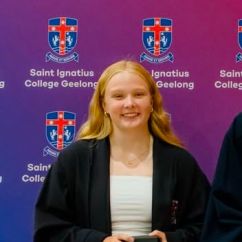
Steph Reynolds grew up in Inverleigh, a small country town near Geelong surrounded by bushland and farmland which inspired her strong appreciation of nature and community. Encouraged by her parents to pursue a wide range of interests, she has cultivated passions that span the environment, theatre, sport and community service.
Each of these passions has played a significant role in Steph’s life. Since Year 5, she has been involved in musical theatre through school productions and the Geelong Society of Operatic & Dramatic Arts, where performing has helped build her confidence and fostered lasting friendships.
A lifelong swimmer, she now works as a swim teacher and volunteers with the Warrnambool Surf Life Saving Club, helping young people develop confidence and life-saving skills.
Through her education at a Jesuit companion school and participation in its justice and ministry programs, Steph developed a strong commitment to service and a belief that leadership is rooted in helping others — values she continues to put into practice today.
What motivated you to study environmental engineering?
Growing up in regional Victoria instilled in me a sense of awe and appreciation for the environment. At school, my favourite subjects were biology and outdoor and environmental studies. I loved learning how ecosystems work and seeing those concepts unfold around me each day.
Initially, I was set on studying Environmental Science. However, when I discovered the Environmental Engineering and Environmental Science double degree, I realised it offered the best of both worlds. It would allow me not only to understand the science behind environmental issues but also to develop practical solutions to address them. I could combine my passion for nature with problem-solving and innovation, helping to protect and conserve our flora and fauna for future generations.
The humanitarian aspect of engineering also appealed strongly to my desire to serve the community. I was fortunate to travel to Timor-Leste through a school immersion, where I saw the challenges local communities faced due to inadequate infrastructure and environmental management. This experience motivated me to study engineering because I recognised it as a powerful avenue through which I could contribute to positive environmental and social change.
What made you want to attend RMIT, and how did you come across the GAF Scholarship?
I chose RMIT because it was the only university that offered my double degree in Environmental Engineering and Environmental Science. I also enjoy applying my knowledge in real-life settings, so I was impressed by RMIT’s emphasis on practical learning and industry engagement. However, moving away from home and living at college presented financial challenges for my family and me.
As I began searching for scholarships, I came across The George Alexander Foundation. I was excited because I felt understood and supported. The scholarship recognised not only academic achievement but also leadership, community involvement and service — areas that are central to my life.
When I read more about George’s story, I felt an even stronger connection to the Foundation. He had lived in the same region as me and shared my interests in teaching and engineering, as well as values such as a love of learning, a commitment to giving back and a desire to make a positive impact. The scholarship felt like a perfect fit.
What have you found most challenging about university life, and how are you navigating it?
As the first person in my family to attend university, I had no idea how university life worked or what to expect. Coming straight from high school, I entered my first week assuming it would be similar to Year 12, with structured timetables, close guidance from teachers and a clear routine.
I soon discovered that university was very different. While independence certainly has its benefits, I initially found the lack of structure challenging. Learning content independently before classes, managing multiple assignments and taking full responsibility for my studies felt overwhelming at times.
I was also surprised by the size of my cohort. At school, I was used to classes of around 25 students and teachers who knew everyone personally. Suddenly, I found myself in a cohort of 1,800 with no familiar faces. Balancing study, residential college life, sport and sleep was difficult, and I felt quite alone during those first few weeks.
Connection has been the answer to many of these challenges and has significantly eased my transition. This has meant calling my family to hear how things are at home, building friendships at college and in my classes, and reaching out to tutors and peer mentors for help and advice.
I have also found practical strategies helpful. Keeping a detailed calendar allows me to map out classes, assignments, commitments and personal time. While it may sound meticulous, having that structure has greatly reduced my stress and helped me maintain a healthy balance between study and the activities I enjoy.




 Level 3, 111 Collins Street
 +61 3 9650 3188


